
Geauga Projected vs Actual Release
A projected release date is a calculated future point. It is not proof that a person left custody. ODRC uses the combined label “Expected Release Date/Parole Eligibility Date.” One record may also show a “POA/PRD Date,” which is tied to parole-board processing. Both labels must be read as written. Eligibility, an expected exit, a projected parole release, and an accomplished discharge are different events.
Actual release is a recorded custody event. For a Geauga County jail stay, the jail register can show the time, type, authority, and public destination. For an ODRC case, current status, supervision start, and dated board or discharge fields help confirm what occurred. Transfer to another jail, state prison, ICE, or federal custody ends one agency's segment without ending custody as a whole.
Find Geauga Projected Release Dates
The correct lookup begins with the sentence and current authority. A Common Pleas prison commitment points to ODRC, even if the person was first booked at the Geauga County Safety Center. A local jail sentence points to the court judgment and GCSO calculation. Federal, immigration, and pretrial cases require different sources.
- Read the Geauga court docket and judgment to identify pretrial status, a local jail term, or an ODRC commitment.
- For state prison, open the ODRC Offender Search and begin with the fewest reliable fields.
- Open the details record and match DRC number, birth date, sentencing county, docket, and offense.
- Copy the exact “Expected Release Date/Parole Eligibility Date” label and check status, hearing result, and any POA/PRD field.
- For a county term, ask GCSO and the sentencing court to explain the calculation using the judgment and jail-time credit.
- Recheck before relying on the forecast, then obtain the actual release record after the event.
A person held before trial generally has no sentence-based release date. Bond may be posted, yet the jail must receive court paperwork and clear other holds before physical release. Do not turn a bond date into a promised exit time. The Geauga County released-inmate search covers the full court, jail, state, federal, and ICE confirmation path.
Ohio Earned Credit Release Rules
For qualifying confinement that begins on or after April 4, 2024, ORC 2967.194 sets Ohio's earned-credit framework. Eligible people provisionally earn one or five days for each completed month of productive program or activity participation, depending on the statutory category. Completion of a second qualifying program can add up to five days. A qualifying completion award can equal 90 days or ten percent of the term, whichever is less, under the statute.
The ordinary combined participation and completion credit is capped at 15 percent of the stated term. That cap is the source of shorthand that an otherwise eligible person might serve roughly 85 percent. Ohio has no universal rule that every prisoner serves 85 percent. Mandatory terms, excluded offenses, jail-time credit, judicial release, sentence structure, transitional control, and other laws can yield a different date.
Credit can be denied or withdrawn for rule violations and is finalized after a conduct review. The rules also exclude specified mandatory or nonreducible terms, murder-related categories, life without parole, certain ORC 2971.03 terms, and named sexually oriented offenses. Older offense categories may follow different provisions. OAC 5120-2-06 implements the program, while OAC 5120-2-03.2 and 5120-2-04 address calculation and jail-time credit.
Note: Earned credit changes a qualifying calculation; it does not promise release on a date before all sentence and hold checks are complete.
Why Geauga Release Dates Change
A calculated date changes when one of its inputs or legal decisions changes. The source record should identify the factor rather than inviting guesswork. Compare the latest court entry, ODRC details, and holding-authority record.
| Factor | How it affects the date | Where to verify |
|---|---|---|
| Jail-time credit correction | Changes credited days used in the sentence calculation | Sentencing docket and corrections record |
| Earned credit | Adds, denies, finalizes, or withdraws a lawful reduction | ODRC record and governing rule |
| Parole Board action | May grant release, continue a hearing, or set a projected date after denial | ODRC details and public board materials |
| Judicial release | A court order may authorize an earlier release with conditions | Geauga Common Pleas journal entry |
| Another sentence or holder | May keep the person in custody after one term ends | Jail register, court docket, and receiving agency |
| Sentence-record change | Corrects the term, structure, or underlying data | Court and ODRC Central Records |
An ODRC future date can also be recalculated before it becomes an actual discharge. A Geauga County jail record may show release to another authority on the day the local term ends. In both cases, the change should be stated with its source and date.
ODRC Geauga Release Date Fields
ODRC results can show far more than one future date. A detail record may include the admission date, institution or status, offenses, effective sentence, jail-time credit, sentencing county and docket, aggregate term, hearing month, latest hearing result, supervision start and period, and APA office. Not every record has every field, and ODRC warns that the displayed sentence list may be incomplete.
Identity should be checked before dates. Match the DRC number, date of birth, Geauga sentencing information, and docket. `Released` and `APA Supervision` are not synonyms. APA Supervision means the person has left prison but remains under state supervision. `Violator at Large` is a published supervision-violation status, and its displayed address is only the last recorded address.
The official ODRC search screen displays the status and hearing-month fields used to locate an Ohio projected release record.
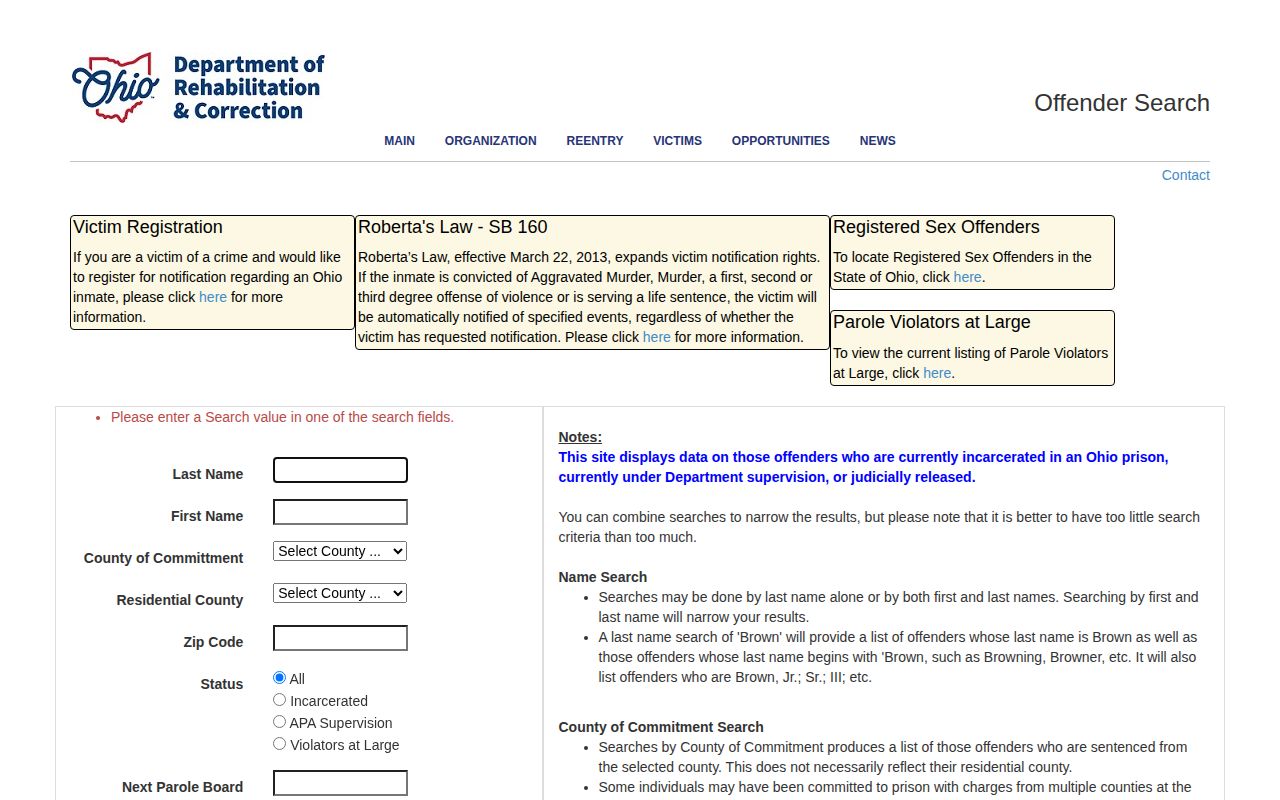
The interface supports the lookup, while the opened details record supplies the person-specific label and dates. ORC 5120.66 calls for a 24-hour update interval, but no rule makes each underlying event appear at once.
Geauga County Jail Date Calculation
A local jail sentence is calculated from the court's judgment and credited days. It is not taken from ODRC's expected-date field unless the person is actually in ODRC custody. Review the Geauga court docket for the sentence, jail-time credit, and later orders. Then ask the Safety Center for the recorded calculation or release segment that can lawfully be provided.
Geauga's family handout explains a separate pretrial timing issue. Bond is posted only at the controlling court during its stated weekday window. The jail cannot release the person until the court paperwork arrives, and processing varies with the day's volume. A court event may therefore occur before the jail-register exit time. No official fixed release hour, weekend timetable, or public transportation plan was found in the research.
Geauga Parole Eligibility Dates
Traditional parole eligibility is governed by ORC 2967.13 for the covered sentences. The first eligible point is not a release order. The Ohio Parole Board can grant release, deny and continue the hearing, or deny and set a projected release date under the applicable rules. OAC 5120:1-1-10 says that after a denial the board must set a projected release date or another hearing within the prescribed limit and give written reasons.
The public ODRC search can be filtered by the next Parole Board Hearing Date in `YYYYMM`. The detail record can show the hearing or review month and the latest result. Schedules change, so note the date checked. A projected date after denial may allow release without another panel appearance, but it can be rescinded for noncompliance. It remains distinct from an actual discharge.
Geauga Pretrial Release Has No Date
A person awaiting trial at the Safety Center usually does not have a sentence-based projected release date. The next event may depend on bond, a court hearing, a dismissal, a plea, or another order. Even after a court authorizes release, GCSO must receive the paperwork and check for other holds. The family handout states that processing time varies with the number of releases being handled. That makes a predicted clock time unreliable.
Use the court docket to track legal authority, not to infer that the person already left the building. Chardon Municipal Court can hold misdemeanor matters and early felony proceedings within its jurisdiction. The Geauga Common Pleas search covers felony adjudication and other assigned matters. A felony path can begin in Municipal Court and continue in Common Pleas, so one court's no-hit may not end the search. Match the case number and read dated journal entries.
The permanent GCSO jail register is the better source for the completed event. Ask for the public release date and time, release type, releasing authority, and destination when disclosable. If the entry shows a transfer, the person remained in custody with the receiving agency. A pretrial release forecast should never be stated as though it were a fixed prison discharge date.
Correct Geauga Release Date Errors
When two sources display different dates, preserve both instead of choosing one. A court time may mark the filing of an order. A jail time marks physical release processing. An ODRC field may identify eligibility or an expected date, while supervision starts on the actual prison exit. Each timestamp can be accurate for a different event.
For a Geauga jail discrepancy, identify the booking, the disputed field, and the source that conflicts with it. Submit a focused request through the GCSO records form and ask the custodian to explain the correction process. The retention schedule's permanent jail-register and booking-file series provides a durable record base. It does not guarantee that every requested item is public, so ask for separable public portions and a legal basis for a redaction.
For ODRC, use the sentencing docket shown in the details record and contact Central Records at P.O. Box 430, Columbus, Ohio 43216. ODRC itself warns that sentence information may be incomplete. The originating Geauga court can address its judgment or jail-time-credit entry, while ODRC can address the public corrections field. A correction request should name the field and source, not ask either office to decide an open legal question.
Confirm Geauga County Release Dates
After a future date approaches, confirm it with the authority that holds the person. For the Safety Center, request the jail-register release fields and compare them with the court order. For ODRC, recheck status, supervision start, board result, and the date fields. A state release may continue as APA supervision. A county release may instead be a transfer.
Ohio VINE can provide a participating custody or release alert by telephone, email, or text, but the Ohio Attorney General warns users not to rely on VINE alone. Municipal-jail offenders are excluded from the statewide brochure's coverage. The VINE Inmate Check explains the one-person search and PIN confirmation process. Confirm an urgent discrepancy with the facility itself.
Keep the check date and exact label. “Expected Release Date/Parole Eligibility Date” is useful evidence of the published forecast. A later `Released` or `APA Supervision` status, coupled with a dated custody or supervision event, answers a different and stronger question.