
Common Pleas Release Path
Geauga County Common Pleas General Division handles felony criminal cases. A judgment may send a defendant to the Geauga County Safety Center for a local term, commit the person to the Ohio Department of Rehabilitation and Correction, place the person on community control, or authorize judicial release under stated terms. Community control is court-ordered supervision in the community. Judicial release is a court-approved early release from a prison term and may include added conditions. Neither label proves that staff at a jail or prison completed the physical discharge at the same moment the order was filed.
The destination matters. A commitment to ODRC continues custody in the state system. A holder from another county or federal authority can also prevent a community exit. When the order grants bond or judicial release, read every condition and later entry because a stay, capias, warrant, or other order may change the result. The Geauga County released-inmate search and record routes on the home page explain how to pair the legal order with the custody agency's dated release entry.
Confirm Common Pleas Release Records
Begin at the exact Common Pleas eServices search. Search by a stable case number when one is known. A name search can identify candidates, but matching the case number, date of birth when displayed, charge, and court history reduces the chance of confusing two people. Open the chronological docket rather than relying on a short result label. Entries may show the bond, plea or verdict, sentence, commitment, judicial-release motion and order, community-control terms, termination, or a later warrant.
- Locate the correct criminal case and record its case number.
- Read the latest docket entries and open the linked judgment documents.
- Identify the exact order, its filing date, custody terms, jail-time credit, and any supervision conditions.
- Check GCSO for a county-jail event or ODRC for a state-prison event.
- Preserve both dates if the order date and physical release date differ.
A felony can begin with a preliminary proceeding in Chardon Municipal Court before indictment in Common Pleas. If the Common Pleas docket starts after an earlier municipal case, use the case numbers and charging documents to connect the records. A no-hit in one court is not final. The court that issued the release or commitment order must be identified from the papers, not guessed from the fact that a person once stayed at the Safety Center.
The municipal and Common Pleas timestamps can mark different phases of one case. An early bond or preliminary entry may sit in the municipal file, while indictment, sentence, prison commitment, or judicial release appears later in Common Pleas. Keep each court's case number beside its own entry date. That method preserves the chain of authority and avoids treating a transfer between court stages as a fresh physical release.
Geauga Judgment Entry Fields
Judgment entries give context that a transient custody display cannot. Read the fields together. Jail-time credit is time the court recognizes toward a sentence, not a stand-alone statement that release has occurred. A commitment records the authority for transfer to prison. A judicial-release order may impose community control, while a termination entry can show when that court supervision ended.
| Record field | What it can establish | What it cannot establish alone |
|---|---|---|
| Case and docket number | The court file tied to the charge | Present physical custody |
| Bond entry | Terms for pretrial release | The minute jail processing ended |
| Sentence and jail-time credit | The ordered term and credited time | A final discharge date without custody confirmation |
| Commitment | Authority to send a person to ODRC | Community release from Geauga |
| Judicial release | The court's release order and conditions | Completion of all later supervision |
| Community-control termination | The end or change of that court term | The status of another case or agency hold |
Case status terms also need care. “Closed” does not always mean a person left custody, and “active” does not mean the person remains confined. A case may stay active through community control or appeal after release. A closed case may exist beside another case, detainer, or prison term. Use the dated entries and the named authority instead of translating a broad case label into a custody conclusion.
Note: A later capias or warrant is a new legal event and does not erase the fact that an earlier release may have occurred.
View Geauga Court Record Access
The Geauga County Clerk of Courts access route identifies the official office behind Common Pleas criminal records.
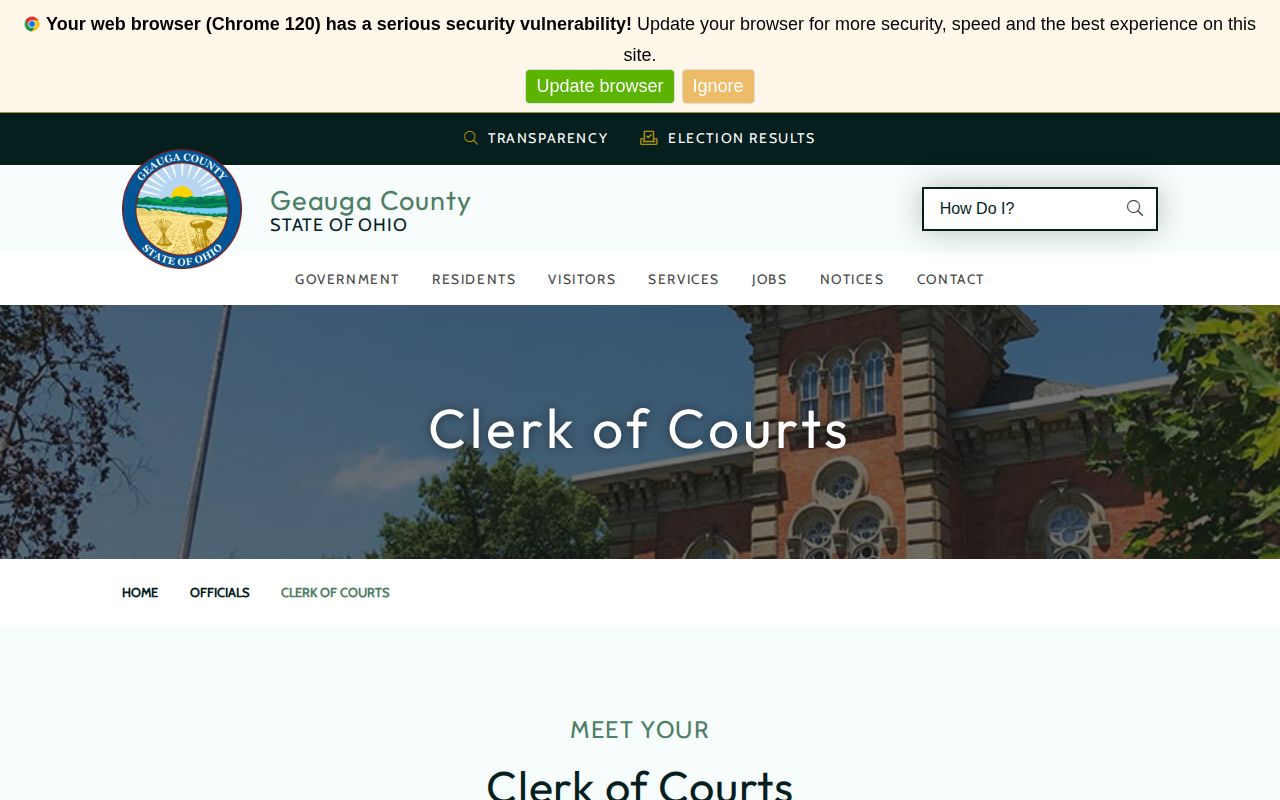
The official route matters when similar names or unofficial indexes produce mixed results. Once the correct docket is found, request the filed judgment entry if the online view is incomplete or if a readable copy is needed. The Clerk maintains General Division and Eleventh District Court of Appeals records, while GCSO maintains the separate jail record.
Common Pleas Records Contact
The Clerk Legal Office accepts requests in person, by phone, and online. Its published process says a requester need not provide an identity or reason. Ask for an existing docket item or judgment entry by case number and filing date rather than asking staff to determine whether someone was released. That keeps the request tied to a record the office maintains.
100 Short Court Street, Suite 300
Chardon, OH
440-279-1960
Monday through Friday, 8:00 a.m. to 4:30 p.m.
Official court record request
Published court-copy charges are ten cents per page for regular copies and one dollar per page for certified copies, with postage extra. Digital copies are redacted and cannot be digitally certified. Unredacted pickup requires identification. Those amounts apply to the Clerk's court-copy service, not to sheriff booking records. Check the live request page before ordering because office terms can change.
Match Geauga Custody Records
After finding the order, select the custody source named by the case. For a Safety Center stay, request the public portions of the jail-register entry and booking file from the GCSO records form. Ask for admission and release or transfer fields, the exact release date and time, releasing authority and type, and destination when recorded and public. Geauga's retention schedule marks the jail register and booking files as permanent series, which supports a focused historical request after a person is gone from any live view.
For a prison commitment, use the ODRC offender record. Match the DRC number, sentencing county, docket, offense, and sentence. “Released” and “APA Supervision” have different meanings. APA Supervision means the person has left prison but remains under the Ohio Adult Parole Authority. A future expected release or parole-eligibility date is not proof of an actual exit. The ODRC details and the Common Pleas judgment should agree on the core identity and sentence before either is treated as the matching record.
- Community control
- Common Pleas supervision in the community, often called county probation.
- Judicial release
- A court-approved release from a prison term subject to the order's conditions.
- Jail-time credit
- Time credited toward the sentence, not an automatic release notice.
- Commitment
- A court order transferring the person into the named corrections authority.
Geauga Release Record Limits
Ohio's Public Records Act governs access to qualifying records but also contains exclusions. Specified probation, parole, community-control, post-release-control, and release-proceeding records may fall outside the Act's general definition. Start with the public docket and judgment entries rather than demanding a full supervision file. If part of a requested record is withheld, ask the custodian for the legal basis and for any reasonably separable public portions.
Sealing or expungement can change ordinary visibility. Ohio Revised Code sections 2953.32 through 2953.34 address relevant eligibility, dismissed or not-guilty matters, and the effect of an order. A sealed case may no longer appear in routine public search even though narrow lawful access remains. Therefore, a missing online result cannot prove that no case or custody event existed. It only establishes what the public interface returned at the time of the search.
Two dates may both be accurate. The docket shows when the judge or clerk entered an order. The custody record shows when jail or prison staff recorded the release or transfer. If they differ, keep both source labels and ask the holding agency to reconcile the processing interval. Do not replace either date with an estimate.
For an archival check, save the judgment-entry title and filing date with the requested copy. Those details let the Clerk identify the same document later and let GCSO or ODRC compare it with the correct custody event. A search-results page alone can change or omit document context, while the filed entry remains the stronger court source.
Note: Common Pleas records explain the court's action; they never turn this sentencing pathway into a jail or current-custody locator.