
BOP Release Path
The Federal Bureau of Prisons holds people serving federal sentences. That is different from U.S. Marshals Service pretrial or remand custody, which can use contract facilities and transport people between courts and holding sites. A Geauga County address, arrest, or prior jail stay does not establish that a person entered BOP custody. The federal judgment and BOP record must identify that path.
A BOP result with a past Release Date and Location shown as RELEASED, or with no institution, confirms departure from BOP custody on the displayed date. It does not establish freedom from federal supervised release, a state sentence, an immigration transfer, or another hold. FCI and FSL Elkton are in Columbiana County, not Geauga County. They are contextual nearby institutions, not an automatic placement for federal cases arising in Geauga.
Confirm a BOP Release
Use the official BOP Inmate Locator. Search by exact name with optional age, race, and sex filters, or use a BOP register, DCDC, FBI, or INS number. An agency identifier is stronger than a name. If a name search returns more than one person, match the register number, age, and case record before reading the release field.
- Search by register number when it is known.
- Otherwise use the exact name and only the filters supported by reliable facts.
- Match the person before recording Location or Release Date.
- Read RELEASED, a named institution, UNKNOWN, or IN TRANSIT literally.
- Compare the result with the federal judgment and later docket entries.
The locator covers federal inmate records from 1982 to the present and many people released after 1982. Older records may require research through the National Archives rather than a conclusion based on a no-hit. Spelling changes and identifiers also matter. Record the query, result label, date checked, and register number so a later reader knows exactly what the official system reported.
The four identifier routes are not interchangeable labels. A BOP register number belongs to the Bureau's record, while DCDC, FBI, and INS numbers originate in other justice or immigration systems and can help locate the matching federal entry. Copy the identifier exactly from a reliable case source. Do not infer one from a name, an old booking number, or the county where the case began.
The Geauga County release search identifies the separate county, Ohio, immigration, and federal-pretrial routes when BOP is not the correct authority.
BOP Release Result Fields
BOP publishes a compact result. Its official columns are name, register number, age, race, sex, Release Date, and Location. The limited field set makes the federal docket important for legal context. The locator can establish what BOP reports about custody, while the docket can show the judgment, release order, supervised-release term, or later proceeding.
| BOP field or label | Meaning | Necessary caution |
|---|---|---|
| Register number | Stable BOP identity key | Match it to the case when possible |
| Past Release Date | Date of departure when paired with RELEASED or no institution | Does not end all supervision or other custody |
| Future Release Date | Projected date in the current record | Can change |
| RELEASED | No longer in BOP custody as reported | Not proof of release from every authority |
| UNKNOWN | The release term has not been determined | Not a release |
| IN TRANSIT | The person is moving within federal custody operations | Not a community exit |
A named institution indicates the current BOP location reported by the tool, subject to normal update limits. A blank or missing result does not prove release. It can reflect pre-1982 coverage limits, name mismatch, no BOP commitment, or a person still in the USMS pretrial path. Identify the system before interpreting the absence.
View Federal Release Search
The BOP Inmate Locator search interface provides the official name and number routes for federal sentenced-custody records.
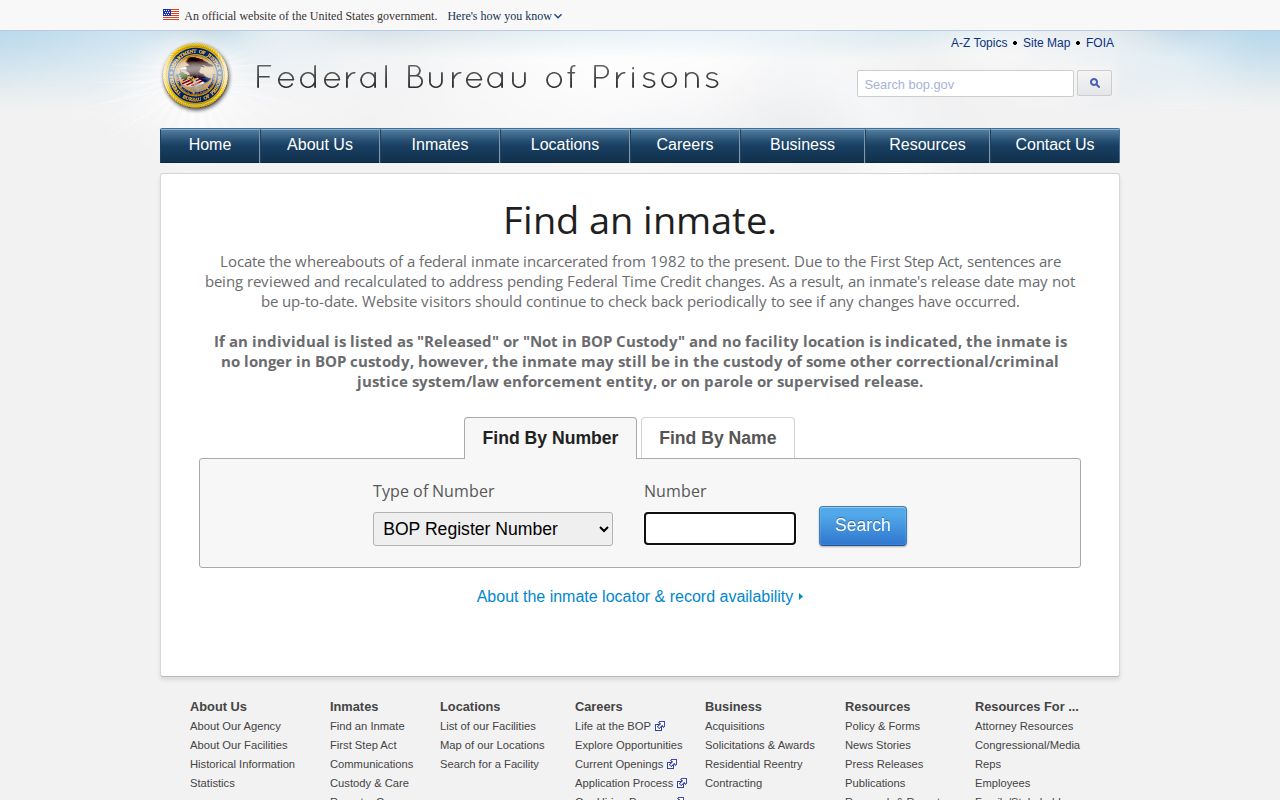
Use a number search when the federal docket supplies one. When only a name is available, avoid adding a county assumption because BOP placement is national. Open and record only the matching official result.
Interpret BOP Release Status
The BOP explanation of federal inmate records controls the label meanings. RELEASED is a BOP custody result, not a broad statement that the person has no remaining obligations. Federal supervised release is a term imposed by the court and served after imprisonment. The judgment and docket provide that context.
A future release date is projected. It can change, including through sentence calculation or First Step Act recalculation. UNKNOWN means the term has not been determined. IN TRANSIT indicates movement and should never be described as release. If a person leaves a contract jail under USMS authority before a BOP commitment, the event may appear in the federal docket without becoming a BOP release result.
- Federal sentenced custody
- Imprisonment after a federal sentence, generally within the BOP system.
- Supervised release
- A court-ordered federal supervision term after imprisonment.
- Projected date
- A future estimate that can change before the custody event.
- Transfer
- Movement between authorities or facilities, not community release.
Note: A historical BOP release can coexist with a later federal case, state custody, or immigration event, each with its own source and date.
Match Federal Release Records
Use the federal docket to answer why custody changed. Look for the judgment, commitment, sentence, release order, supervised-release terms, revocation proceedings, or later court action. Match the name and case number to the BOP register number when the filings provide it. A locator date without the judgment lacks the legal terms, while a court order without the locator may not show the day BOP processed the release.
Geauga County is within the Northern District of Ohio for the U.S. Marshals Service context. That does not mean every federal matter connected to the county resulted in a BOP sentence. Pretrial release, dismissal, transfer, or a different district can produce another path. Search the docket tied to the actual case rather than choosing a district or prison from geography alone.
A two-source note should preserve each fact: “BOP reported RELEASED with the displayed past date when checked,” followed by the judgment or docket entry that governs the sentence and supervision. If the dates differ, keep both and request clarification from the agency that created the disputed field.
The docket can also distinguish sentence completion from a court-ordered release or later revocation. Those events may affect the legal timeline without changing the meaning of an older BOP locator row. Preserve the original BOP date and add the later court event as a new dated fact. Combining them into one undated statement can hide whether the person left prison, began supervision, or returned to custody.
BOP Release Record Limits
The locator is the first federal sentenced-custody source. Its post-1982 coverage boundary means a no-result for an older person requires a different archival route. BOP's records explanation points readers toward the proper historical context rather than treating every missing result as evidence of no custody.
Nationwide sentenced-custody system
BOP Inmate Locator
About Federal Inmate Records
No BOP institution identified in Geauga County
For the court record, ask the court or its authorized record system for the existing judgment or order tied to the case number. The available BOP sources establish the public locator and the older-record archive fallback, not a general BOP release-record request procedure. Keep any additional inquiry tied to the live official directions and do not assume that fields beyond the public result can be obtained.
For pre-1982 custody, the public locator's date boundary should be stated in the research note. An archival no-result is not a present-status finding. Record which years were searched, then follow the official historical-record direction. This keeps an old federal sentence from being mistaken for a recent Geauga County jail event or an active BOP placement.
Geauga Federal Release Boundaries
The Geauga County Safety Center may hold people for local, immigration, or federal authorities, but a departure from that building does not automatically become a BOP release. Transfer to USMS, ICE, another contract jail, or BOP is continued custody elsewhere. The GCSO jail record answers when the county segment ended. The receiving system answers what happened next.
Ohio DRC records also cannot confirm a BOP release. ODRC is the state prison and APA system. BOP is the federal sentenced system. USMS handles federal pretrial, remand, and transport functions. ICE has its own recent detainee locator. A correct search begins by naming the authority shown in the court or custody record.
Record the BOP register number, exact status, Release Date, Location, and check date. Then preserve the federal docket entry that explains the legal effect. That approach confirms a federal custody change without claiming that BOP's compact result resolves every later obligation or placement.