
Ohio DRC Release Path
A Geauga County felony commitment can lead to an ODRC institution anywhere the department assigns. Geographic proximity is not proof of placement. No state prison was identified within the county, and nearby Northeast Ohio institutions should not be named as a person's destination without an individual record. The statewide search supplies the institution or status connected to the matching DRC record.
After prison, the record may show Released or APA Supervision. APA Supervision means the person has left prison but remains under the Ohio Adult Parole Authority. A Violator at Large entry is a published supervision-violation status, not proof of a present physical location. The search warns that a displayed address can be the last recorded address. A transfer between institutions is continued custody, while judicial release may return a person to court-ordered community control. Keep the source label intact.
Confirm an ODRC Release
Open the ODRC Offender Search and begin with the fewest reliable criteria. The interface supports first and last name, county of commitment, residential county, ZIP, status, next parole-board hearing month, and DRC number. Status choices include All, Incarcerated, Released, APA Supervision, and Violators at Large. Too many fields can hide a valid record when one value has changed or is entered differently.
- Search by DRC number when available, or use a careful name search.
- Select Released, APA Supervision, or All according to the question.
- Open the detail result and match date of birth, DRC number, offense, Geauga sentencing county, and docket.
- Read status, date fields, supervision dates, APA office, and hearing result together.
- Check the Geauga Common Pleas judgment for the sentence or judicial-release authority.
The number guidance says A and R prefixes generally identify men and W identifies women, with six digits used in the number. A five-digit women's number is padded with a leading zero. Name alone is weaker than the DRC number and docket. If the details conflict with the sentencing record, preserve both source dates and contact Central Records rather than choosing one result.
The Geauga County release search explains how a separate Safety Center stay or federal transfer is checked when the state record points to another authority.
ODRC Release Record Fields
The detail page can contain more than a single status. Not every record has every field, and ODRC warns that its sentence list may be incomplete. Identity fields should be matched before the release information is read. The Geauga sentencing county and docket are especially useful when a common name produces several results.
| Field | How to read it | Limit |
|---|---|---|
| Status and institution | Current ODRC category or listed placement | Does not resolve custody in another system |
| Expected Release Date/Parole Eligibility Date | Combined expected or first-eligibility field | Not a confirmed actual release |
| POA/PRD Date | Parole-board presumptive or projected field | Can change before departure |
| Supervision start and period | APA timeline after prison | Must be read with present status |
| Next hearing/review month | Current board scheduling field | Schedules can change |
| Sentencing county and docket | Link to the controlling Geauga case | Not a prison processing timestamp |
Other public details can include the photograph, admission date, offense and count, Ohio Revised Code section, effective sentence date, jail-time credit, degree, judge, aggregate sentence, latest hearing or review result, APA office, and public supervision notes. Copy exact labels when recording a result. Replacing “eligibility” with “release” creates a false level of certainty.
View Ohio Release Search
The official Ohio search interface shows the status filters and parole-hearing month field used for statewide records.
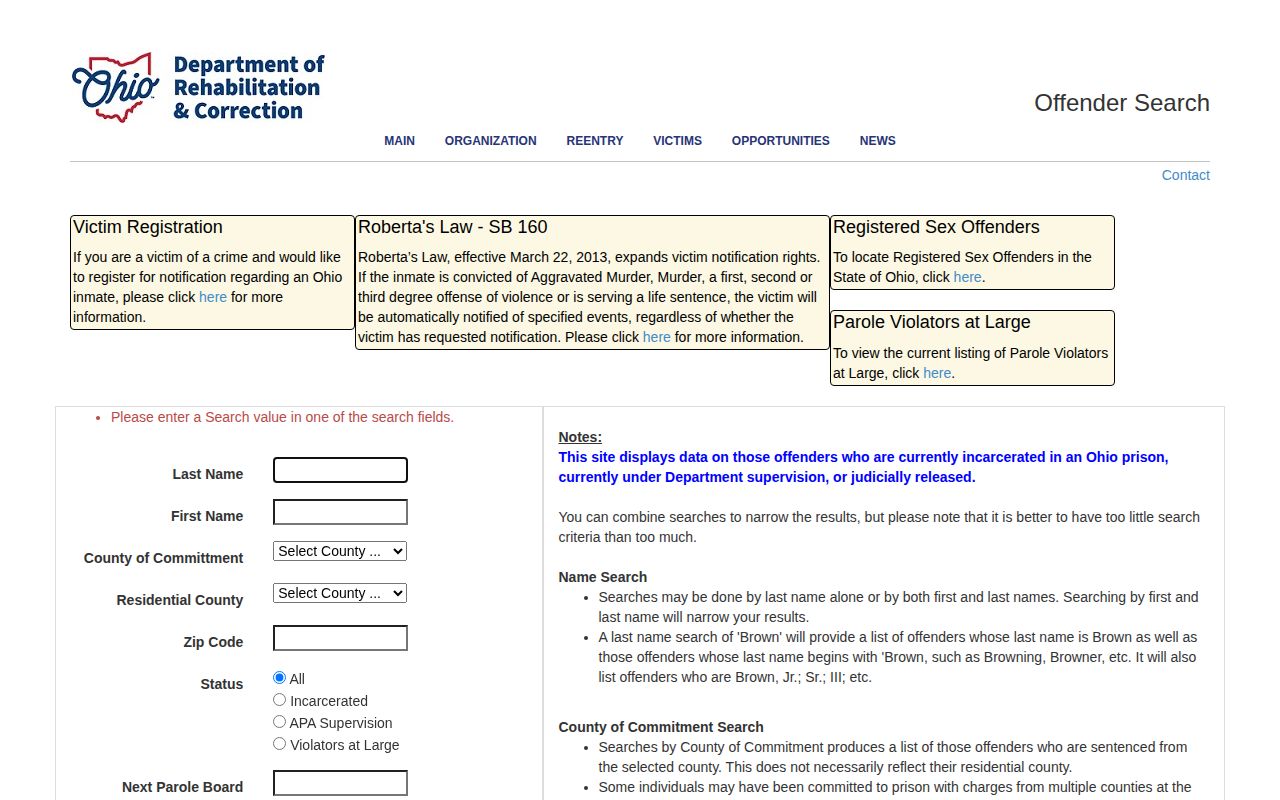
Use the screen to narrow the statewide set, then open a detail page for the actual fields. A blank result can reflect spelling, excessive criteria, a different system, or a record outside the selected status. It cannot by itself prove that a person was never imprisoned or released.
ODRC Expected Release Dates
ODRC's principal combined label is “Expected Release Date/Parole Eligibility Date.” The record may also show “POA/PRD Date.” Expected release, first parole eligibility, a presumptive or projected board date, and actual discharge are different milestones. Confirm an accomplished departure through the current status, supervision start, hearing result, and other dated entries.
For qualifying confinement beginning April 4, 2024, Ohio Revised Code 2967.194 establishes earned credit. Eligible people provisionally earn one or five days per completed month of qualifying activity, depending on the statutory category, with limited additional completion credit. The statute includes caps, exclusions, conduct review, and withdrawal rules. Ohio does not impose one universal rule that every person serves eighty-five percent of a sentence.
A projected date can change when jail-time credit is corrected, earned credit is added or withdrawn, the sentence record changes, a board decision changes, a court grants release, or another sentence or holder applies. Mandatory terms and excluded offenses also matter. The date field must therefore be recorded with its label and check date.
Note: County jail sentences follow the court judgment and county record, not the ODRC date field unless the person actually entered state custody.
ODRC Parole Release Records
The Ohio Parole Board is part of APA and ODRC. Its living public calendar is reached through the offender search by entering the Next Parole Board Hearing Date as a year and month in YYYYMM format. An individual details record can show the next hearing or review month and the latest hearing or review type and result. Because schedules change, record the search date and check again before relying on a future month.
Outcomes should be stated from the actual record. A result may be a grant, a denial with another hearing, or a denial with a projected release date. Under Ohio Administrative Code 5120:1-1-10, a projected date after denial can allow later release without another panel appearance, but it can be rescinded for noncompliance. It is not an actual discharge entry.
- Released
- The public ODRC category indicating departure from its custody or supervision record as displayed.
- APA Supervision
- Release from prison with state supervision still active.
- Violator at Large
- A published supervision-violation status with last-recorded location limits.
- Parole eligibility
- The point when a covered sentence may receive release consideration, not a promised exit.
ODRC Discharge Record Contact
Begin with the public database. For a specific correction or an additionally disclosable state record, direct a narrow request to ODRC Central Records. Identify the person by DRC number, name, and Geauga sentencing docket. Name the disputed field or requested discharge event. Do not ask the office to compile a narrative that does not already exist.
Attn: Central Records
P.O. Box 430
Columbus, OH 43216
ODRC Offender Search
No public counter hours verified in the research
ORC 5120.21 requires the state record to contain discharge information, but it does not make the entire inmate or APA file public. The law permits specified disclosures such as name, convictions, photograph, and current or past incarceration or supervision status. Ask for public portions and the legal basis for any withheld material.
ORC 5120.66 requires the public database to update every twenty-four hours and describes notices for events such as judicial release, hearings, transitional control, escape and capture, death, and impending release. That interval is a database rule, not a promise that each event appears instantly. For an urgent mismatch, keep the check time and ask ODRC to compare the public field with its source record.
Geauga State Release Boundaries
The Geauga Common Pleas judgment explains the commitment, sentence, jail-time credit, or judicial release order. ODRC records the state custody and supervision fields. A court entry may precede physical release, so the two-source check keeps the legal authority separate from the corrections event. A later warrant, holder, or supervision violation is a later event and should retain its own date.
A disappearance from the Geauga County Safety Center can mean transfer to ODRC rather than community release. Conversely, a person released from an ODRC institution should not be sought in the sheriff's county release list. No official rolling Geauga release feed was found, and neither source substitutes for the other.
Record the exact ODRC label, DRC number, check date, and matching Geauga docket. This preserves what the agency actually reported and prevents an expected date, old address, or institution transfer from being recast as a confirmed release.
Always distinguish the public database update time from the underlying custody event time.