
Geauga County Release Records
A Geauga County release marks the end of one agency's custody segment. It does not always mean that a person walked out free of every hold. The Geauga County Safety Center may release someone on bond, after a court order, after completion of a jail term, or to another authority. A transfer to an Ohio prison, another county, the U.S. Marshals Service, or Immigration and Customs Enforcement keeps the person in custody elsewhere. The release type and destination matter as much as the time.
No one document covers all Geauga County released inmates. The local proof may be a jail-register line, part of a booking file, and a court order. An Ohio prison release appears through the Ohio Department of Rehabilitation and Correction, called ODRC. A federal result comes from the Bureau of Prisons or the federal docket. Each source should be read in its own terms. “Released” from one system must not be changed into “free” when another hold may still apply.
- Discharge
- The documented end of a term or corrections status under the rules that govern it.
- Time served
- Completion of the custodial part reflected in the court and jail record.
- Detainer
- A request by another authority to keep or take custody when local release would otherwise occur.
- Transfer
- Movement to another agency or facility, not a community release.
Geauga County Release Types
The releasing authority and next destination determine where the trail continues. Bond leaves the criminal case open. A dismissal can end one charge while another hold remains. Sentence completion ends the listed jail term, but supervision or another case may follow. Geauga County court and jail entries should be paired before drawing a conclusion.
| Release type | Meaning in Geauga County | Next record |
|---|---|---|
| Bond or court release | Local pretrial custody ends under court authority and conditions. | Controlling court docket plus GCSO release entry |
| Time served | The jail portion shown in that case has ended. | Jail register and sentencing docket |
| Dismissal or acquittal | A case disposition changed, subject to any other hold. | Municipal or Common Pleas journal entries |
| ODRC commitment | The person leaves county custody for state prison. | ODRC Offender Search |
| ICE, USMS, or other hold | The sheriff's segment ends through transfer. | Receiving authority and court record |
| Community control or APA supervision | Custody has ended, but court or state supervision continues. | Common Pleas docket or ODRC details |
Deceased is also a custody termination field, but it is not a release. Precise wording protects the distinction. A record should retain the agency label, event date, and stated disposition.
Geauga County Release Record Fields
The GCSO retention schedule identifies the jail register and booking files as permanent series. That supports a historical request after a person has dropped from any live custody view. Permanent retention does not make every line public. Security, privacy, sealed-case, and other legal limits can still require a redaction. Ask for the public portions and request the legal basis for anything withheld.
| Field | What it can establish |
|---|---|
| Name and aliases | The identity associated with the booking |
| Booking number | A stable link to the local booking file |
| Admission date and time | When GCSO recorded entry into custody |
| Arresting or holding agency | Which authority placed or kept the person there |
| Charge, court, and case number | The docket that explains legal authority |
| Bond | The bond record, not proof of the physical exit time |
| Release authority and type | Why the local custody segment ended |
| Release date and time | When the jail recorded the departure |
| Transfer destination | Whether custody continued with another authority, if public |
| Booking photograph | The image tied to that booking, subject to access limits |
A court docket answers a different question. It can show bond, dismissal, sentence, jail-time credit, judicial release, community control, a warrant, or sealing. It may not show the minute GCSO completed processing. The jail time and court authority should be saved together when exact timing matters.
Request Geauga County Release Records
The GCSO records-request form is the official route for a named jail-register entry or booking file. A focused request is more useful than asking the office to investigate where a person went. Ohio law does not set one universal response deadline, and the reviewed sheriff pages did not publish a copy price. Ask for electronic records and check current costs on the live form.
- Identify the person with a full name, booking number, case number, and a narrow date range when known.
- Name the existing jail-register entry and booking file rather than requesting a new summary.
- Ask for admission and release timestamps, release type, releasing authority, and a public transfer destination.
- Request the public booking photograph only if it is needed, and ask that any lawful redaction be explained.
- Compare the response with the correct Municipal or Common Pleas docket.
The official request screen shows the county's intake fields and is the best place to check current submission requirements.
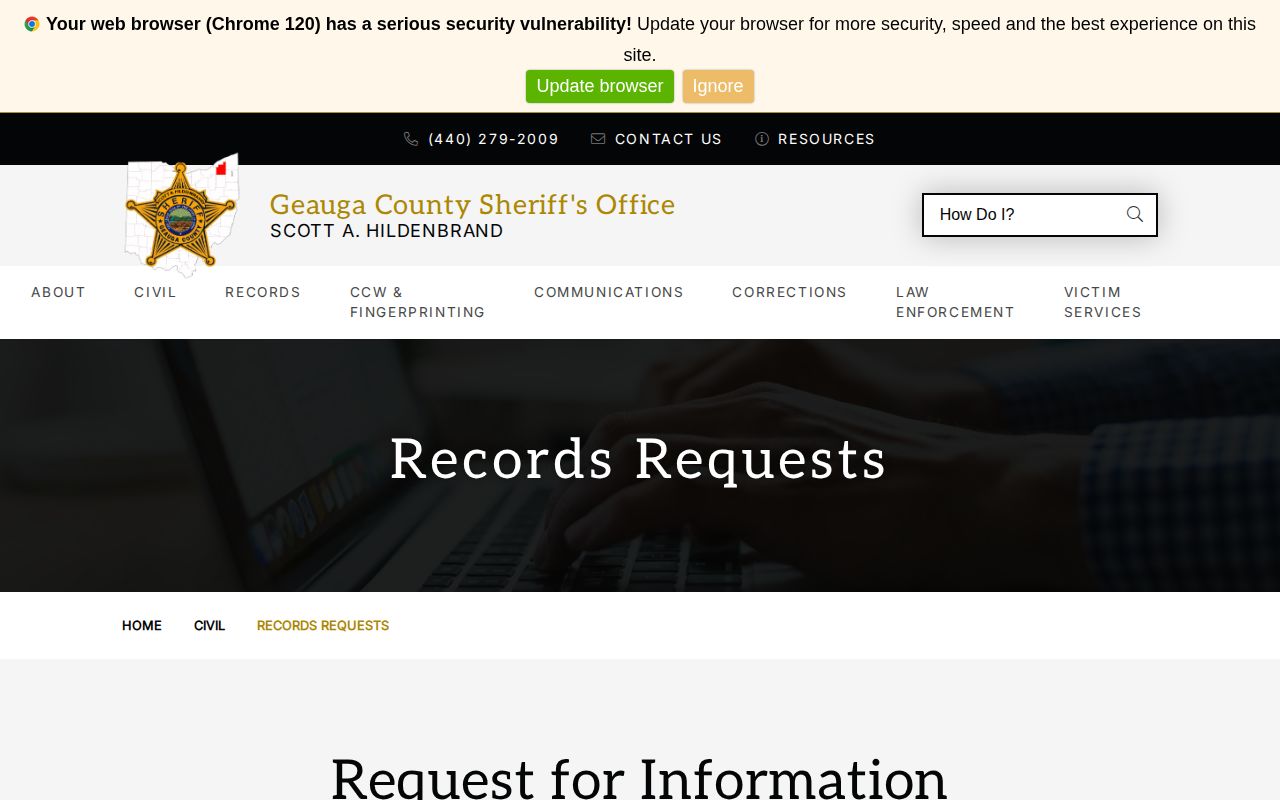
The form starts the records process; it does not itself confirm release. For routing help, GCSO records can be reached at 440-279-2009 option 4. The Corrections page also identifies extension 4411, and the fax number is 440-286-3251.
Note: Ask for existing records in a defined span so the office need not create a new recent-release report.
When Geauga County Bond Releases
Geauga's official family handout gives a local timing rule that a generic roster cannot show. Bond is posted at the court that controls the case, Monday through Friday except holidays, from 8:00 a.m. to 4:00 p.m. The person posting bond must know whether the matter belongs to Chardon Municipal Court or Geauga Common Pleas. That court step is not the physical release event.
The Safety Center must receive the court paperwork before staff can release the person. Processing time varies with that day's release volume. A bond receipt or docket time can therefore precede the jail-register release time. For the exact Geauga County release, request the GCSO timestamp rather than treating the payment time as the exit time.
Geauga County Release Record Law
Ohio Revised Code 149.43 governs access to qualifying public records and lists many exclusions. It does not make every jail, probation, parole, or prison file open. The statute excludes specified supervision and release-proceeding records. For ODRC, ORC 5120.21 limits the full inmate and APA file while allowing named public fields, including a photograph and current or past supervision or incarceration status.
Ohio sealing and expungement rules in ORC 2953.32 through 2953.34 can change public visibility. A sealed case may vanish from ordinary search while limited legal access remains. A no-hit is not proof that no booking or prior custody existed. Juvenile records require a separate confidential path. For Geauga County released inmates, retention, public access, and online visibility are three different questions.
Geauga County Custody Transfers
The GCSO Corrections page reported 2,087 prisoners processed in 2024. That total included 1,560 new-charge, court-order-violation, or sentence matters from local courts and 319 immigration detainees. It also included people held for Cuyahoga County, Ashtabula County, Mayfield, Hunting Valley, and other agencies. These are processing figures, not a count of Geauga County releases and not an average stay.
The mix explains why a missing local name is ambiguous. Departure may mean community release, a state commitment, or an interagency move. The disposition field resolves the path.
Find Geauga County Released Inmates
Start with the last known custody authority. The sheriff and local courts cover a county arrest or jail term. ODRC covers a state-prison commitment and state supervision. BOP covers a federal sentence. The federal docket and USMS cover federal pretrial movement. ICE's locator covers qualifying current and recent immigration custody. Searching one system cannot rule out another.
- Match identity with a booking, DRC, BOP, or A-number when possible, not just a name.
- Check the court that issued the local order and read its dated entries.
- For local custody, request the GCSO release segment and destination from the jail register.
- For state custody, search ODRC with Released, APA Supervision, and All when the status is unclear.
- For federal or immigration custody, use the matching locator and preserve its exact label and check date.
- Use VINE for notifications, then confirm an urgent change with the holding agency.
A two-source check is strongest. The custody record answers when and from whose custody the person left. The court or parole-board record explains the legal authority. If the dates differ, keep both and ask the custody agency to reconcile them.
ODRC Geauga Release Search
The ODRC Offender Search covers people in state prison, under ODRC supervision, or judicially released. It is not a history of every Geauga County jail booking. Use it when the person entered ODRC or APA jurisdiction. Search with fewer reliable fields first, then open the detail record and match the DRC number, birth date, sentencing county, docket, and offense.
| Search field | Use | Key limit |
|---|---|---|
| First and last name | Broad identity search | Spelling and shared names create false matches |
| County of commitment | Narrows the sentencing source | Not the same as current facility |
| Residential county or ZIP | Optional narrowing | Displayed address may be only last recorded |
| Status | All, Incarcerated, Released, APA Supervision, or Violators at Large | Each label has a distinct meaning |
| Hearing date | Parole Board month in YYYYMM | A schedule can change |
| DRC number | Strongest direct identifier | Follow the portal's prefix and padding rules |
The public details may show admission, institution or status, sentence and jail-time credit, “Expected Release Date/Parole Eligibility Date,” a hearing result, “POA/PRD Date,” supervision dates, and APA office. An expected or eligibility date is not a completed release. `APA Supervision` means out of prison but still supervised. `Violator at Large` is a published violation status, not a present-location claim.
The official ODRC search interface shows the status and hearing filters used for a Geauga County state release lookup.
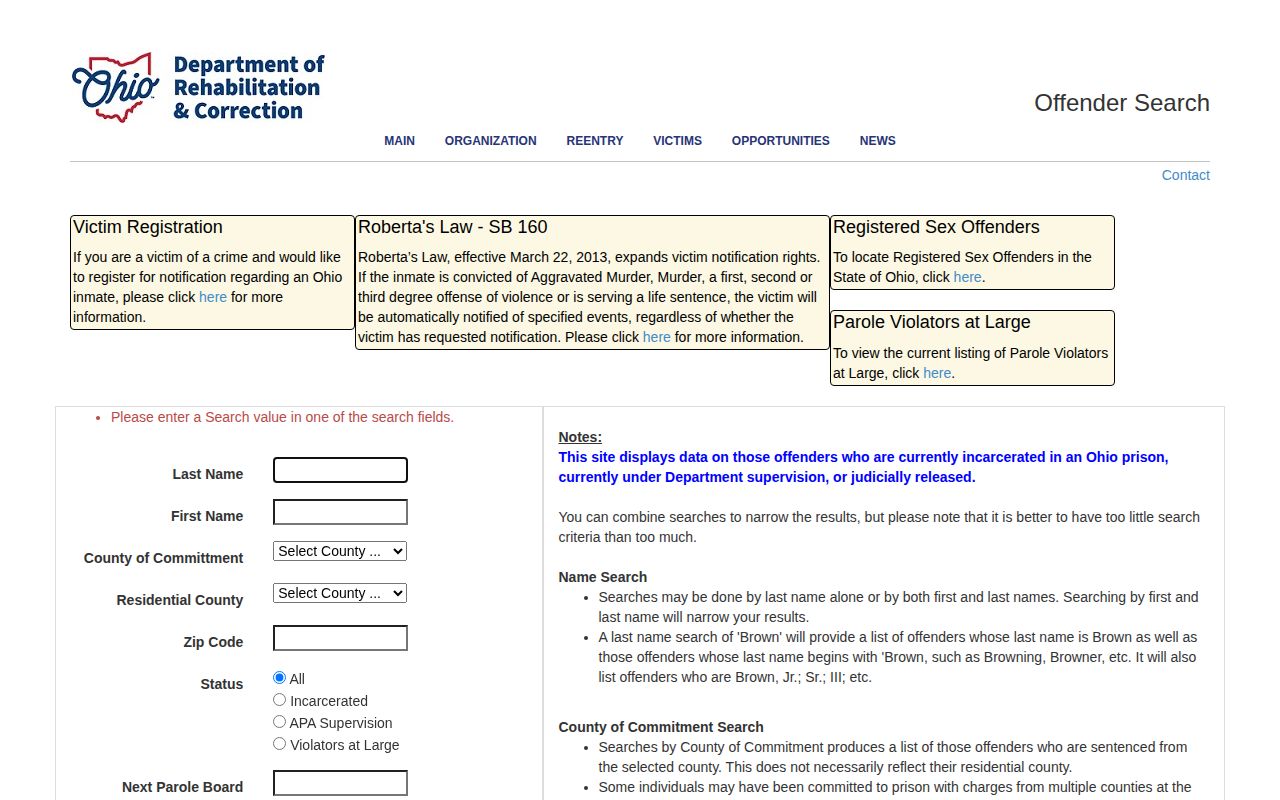
ORC 5120.66 calls for a 24-hour database update interval, but that is not a promise that each source event posts at once. ODRC Central Records is at P.O. Box 430, Columbus, Ohio 43216 for a focused records question.
Geauga Release Records Cross Courts
A Safety Center case can begin in Chardon Municipal Court and later proceed in Geauga Common Pleas, especially when a felony starts with a preliminary municipal event. Search the case number in the system that holds each stage. The Municipal Court eServices search and the Common Pleas eServices search are separate.
Read journal entries, not just an “active” or “closed” label. A case can stay active after bond release. A closed case can coexist with another holder. A later capias or warrant does not erase an earlier release event. The court order provides the reason, while the jail register provides the physical custody timestamp.
Note: One court's no-hit is not final when booking papers show that the case crossed from Municipal to Common Pleas.
Geauga County ICE Release Transfers
The Safety Center also has a documented ICE detention function. An ICE detainer asks the local agency to hold a person for up to 48 hours past the point when local authorities would otherwise release that person, so DHS can assume custody. A GCSO entry that says release to ICE means the county segment ended through transfer. It is not proof of return to the community.
Search the ICE Online Detainee Locator System promptly. It accepts a nine-digit A-number and country of birth, or exact name, birth date, and country. The system covers qualifying people currently detained or released from ICE custody within the last 60 days. Minors are excluded, and records may be withheld or delayed for safety, security, or agency reasons. A no-hit can also mean that the record aged out.
Geauga County Release Supervision
Parole and probation are not the same. Ohio Adult Parole Authority supervision follows qualifying ODRC releases. County probation, also called community control in many court records, follows the sentencing court. To verify APA status, search ODRC for `APA Supervision`, match the person, and use the APA office displayed on the current detail record. No reliable source assigned every Geauga case to one fixed APA office.
For Geauga Common Pleas community control, check the public docket and the Adult Probation Department. Its general office is 440-279-1995 and operates Monday through Friday, 8:00 a.m. to 4:30 p.m. Some supervision files are excluded from the Ohio Public Records Act, so begin with the docket and permitted status fields. The differences and verification steps are covered on the Post-Release Supervision page.
NEOCAP Geauga Release Path
Northeast Ohio Community Alternative Program serves Geauga and four neighboring counties as a community-based correctional facility. It is neither the county jail nor an ODRC prison. A departure may reflect completion, court-directed discharge, a violation, or transfer. Confirm it through NEOCAP and the sentencing docket. Use ODRC only when the person separately has an ODRC or APA record.
Geauga's New Leaf docket shows how records can cross systems. One official court profile follows a participant from ODRC judicial release through NEOCAP and Lake-Geauga Recovery Center into New Leaf supervision. That is a documented example, not a standard route or promise of eligibility. It shows why one return path may leave state, regional, treatment, and local court entries.
Geauga Release Money and Property
The GCSO family handout provides one narrow money rule. Funds left in a commissary account are released only to the inmate, and the original depositor does not receive a refund. No sourced Geauga booking fee, pay-to-stay collection, gate-money benefit, or transport-home plan was found. Those details should not be borrowed from another county.
The Corrections page also says original scanned letters become inmate personal property. If the volume grows too large, the person may have to arrange pickup or destruction. Mail that arrives after departure is returned through the Post Office. These facts do not establish a broad property-desk process, so any unresolved pickup question should go to GCSO.
Correct Geauga County Release Records
Geauga's permanent booking-file retention provides a concrete route when a release entry seems wrong or incomplete. Identify the booking number, the disputed field, the source that conflicts with it, and the date each source was checked. Submit a focused GCSO request for the public jail-register and booking-file portions. Ask the custodian to explain the office's correction process rather than asking it to decide a broad legal question.
For an ODRC field, use the sentencing docket shown on the details page and contact Central Records. ODRC warns that its sentence display may be incomplete. A Geauga court can address its judgment or jail-time-credit entry, while ODRC can address its corrections data. Preserve both records until the offices explain the difference.
Geauga Release Records Changed Address
The current Geauga County Safety Center opened on December 28, 2005, when 47 people moved from the former jail at 13281 Ravenna Road. The present facility is at 12450 Merritt Road. Its 182-bed design includes spaces for women and men in general population plus a 60-bed male Community Service and Work Release component.
This history matters for an older Geauga release search. Archival material may name Ravenna Road even though current records requests and facility contact use Merritt Road. The address difference can mark the age of the record, not a second current county jail.
Compare Geauga Release Sources
Each system proves only its own segment. Keep the exact status term and the date checked. Do not treat silence in one locator as a full custody answer.
- GCSO jail register
- Use it for local admission, release time, type, and a public destination. It does not prove that custody with a receiving authority ended.
- Geauga court docket
- Use it for bond, sentence, dismissal, judicial release, or warrant authority. It does not prove the minute physical processing ended.
- ODRC Offender Search
- Use it for state custody, release, APA, hearing, and expected-date fields. It is not a record of every county jail stay.
- Ohio VINE
- Use it for participating custody information and future alerts. It is not sole proof, and municipal jails are excluded.
- BOP locator
- Use it for federal sentenced-custody location and release dates. It does not prove the end of supervision or custody elsewhere.
- ICE ODLS
- Use it for qualifying current and recent ICE custody. It is not a permanent history or a conclusive no-custody result.
Geauga County Release Pathways
The mapped pages follow the custody system, not just county geography. The Safety Center is the main local jail. Its ICE function needs a separate transfer route. Chardon Municipal and Common Pleas are court pathways, not long-term jails. Juvenile detention uses confidential procedures. NEOCAP is community corrections. ODRC, BOP, and USMS pages explain state and federal records for people whose Geauga connection led into those systems.
- Geauga County Safety Center
- Geauga County Safety Center ICE detention function
- Chardon Municipal Court holding/court-custody pathway
- Geauga County Court of Common Pleas criminal-custody pathway
- Portage-Geauga County Juvenile Detention Center
- Northeast Ohio Community Alternative Program (NEOCAP)
State and federal commitments then move the search outside the county facility system, even when the case began in Geauga County.
- Ohio Department of Rehabilitation and Correction institutions
- Federal Bureau of Prisons institutions
- U.S. Marshals Service contract/pretrial custody
Use the page that matches the last confirmed authority. Geography alone cannot identify where a transfer went.