
Geauga County Three-Day Release Window
The Geauga County Sheriff's Office Corrections channel does not publish an official 72-hour recent-release view. There is no exact feed URL, public list of columns, update cadence, or online photo-retention policy to report. A third-party recent-bookings page cannot fill that gap. Booking records entry into custody, while a release record marks an exit or transfer.
The three-day task therefore starts with the official GCSO records form. Ask for the existing jail-register entries whose recorded release times fall between two exact Eastern Time timestamps. Give both calendar date and clock time. This avoids the moving meaning of “last 72 hours” once staff receive and process the request.
Request Geauga County 72-Hour Releases
A good three-day request asks for records, not an investigation or a newly compiled narrative. It identifies the record series and period. GCSO may redact protected information, and it need not create a custom spreadsheet if one is not already kept. Request the public and reasonably separable portions of the existing entries.
- Choose a fixed 72-hour interval in Eastern Time. State the first and last dates and clock times rather than saying “this weekend.”
- Ask for jail-register or release-log entries with release timestamps inside that interval. If the inquiry is about one person, add booking and case identifiers.
- Specify the public fields needed: name, booking number, admission and release times, release type, releasing authority, and transfer destination.
- Submit through the GCSO form and request electronic copies. Ask for the legal basis if any portion is withheld.
- Read the correct court docket and then check another custody system when the record says transfer rather than community release.
The records line is 440-279-2009, option 4, and the Corrections page lists extension 4411. A telephone inquiry may help identify the right office. Written records remain the durable way to preserve a three-day result. The sheriff publishes no guaranteed response period or fixed copy charge in the reviewed materials, so current terms should be confirmed on the live request form.
For a group request, do not ask the office to decide who counts as “recent.” Give the timestamp test and name the jail-register series. For one person, include the booking or court case number and a narrow date range. Ask for electronic records as kept, not a new analysis. If privacy or security rules affect part of a record, seek the public portions and the cited basis for any redaction. This creates a reproducible record of the period even when the response arrives after the 72-hour window has passed.
Geauga County Weekend Release Timing
A 72-hour span matters because a one-day search can split a weekend. For example, a Monday request can cover Friday morning through Monday morning with clear boundaries. That range does not assume the sheriff maintains a “weekend release” report. It simply identifies existing entries by their recorded timestamps.
Geauga's verified bond practice adds another timing issue. The sheriff's family information says bonds are posted at the court that controls the case on qualifying weekdays, excluding holidays, from 8:00 a.m. to 4:00 p.m. The jail must receive the court paperwork before it releases the person. Processing duration varies with that day's release volume. A bond posted late in one period can produce a jail exit in the next.
No official fixed weekend or holiday discharge schedule was found. Nor did the research locate a fixed release hour, waiting location, exit door, or ride service. Those gaps should not be filled with practices from another Ohio jail. The records interval can cross a holiday, but only GCSO and the case docket can explain the actual event.
Note: Include the local time zone and both endpoints because a rolling phrase can shift before Geauga County staff retrieve the record.
Geauga County 72-Hour Release Fields
No live Geauga County release table supplies preset columns. The useful field set comes from the jail register and booking file described in the research. Ask only for the public portions. Each field answers a different part of a three-day custody change.
| Field to request | Purpose in a 72-hour review |
|---|---|
| Name, aliases, booking number | Links the person to the correct booking instead of relying on a name alone. |
| Admission timestamp | Shows when the county custody segment began and helps separate repeat bookings. |
| Release timestamp | Places the GCSO-recorded exit inside or outside the exact three-day span. |
| Release type or disposition | Distinguishes bond, time served, court release, dismissal, or another recorded event. |
| Releasing authority | Points to the court or agency record that explains the legal basis. |
| Destination or transfer | Separates a return to the community from continued custody under another authority. |
A bond release does not resolve the charge. Time served ends the custodial part recorded there, but supervision or another matter can remain. A dismissal can coexist with a separate holder. A transfer ends GCSO custody without proving that the person is out of custody. Those words should be copied as the source uses them.
Geauga County Release Retention Advantage
Geauga's record-retention schedule provides the core substitute for a transient three-day feed. Schedule GCSO-19 identifies the Jail Register as a cumulative record of inmate bookings and releases and assigns permanent retention. GCSO-2 gives permanent retention to booking files, including booking sheets, copied court papers, inmate records, and other listed material. GCSO-22 also describes a permanent criminal docket with commitments and discharges.
Permanent retention supports requests made after a weekend window has passed. It does not mean that all content must be disclosed without redaction. Ohio's public-record rules, sealing orders, juvenile protections, security concerns, and other statutory limits can affect access. A narrow request helps the custodian separate public release facts from material that cannot be produced.
The official GCSO retention schedule displays the controlling series and periods.
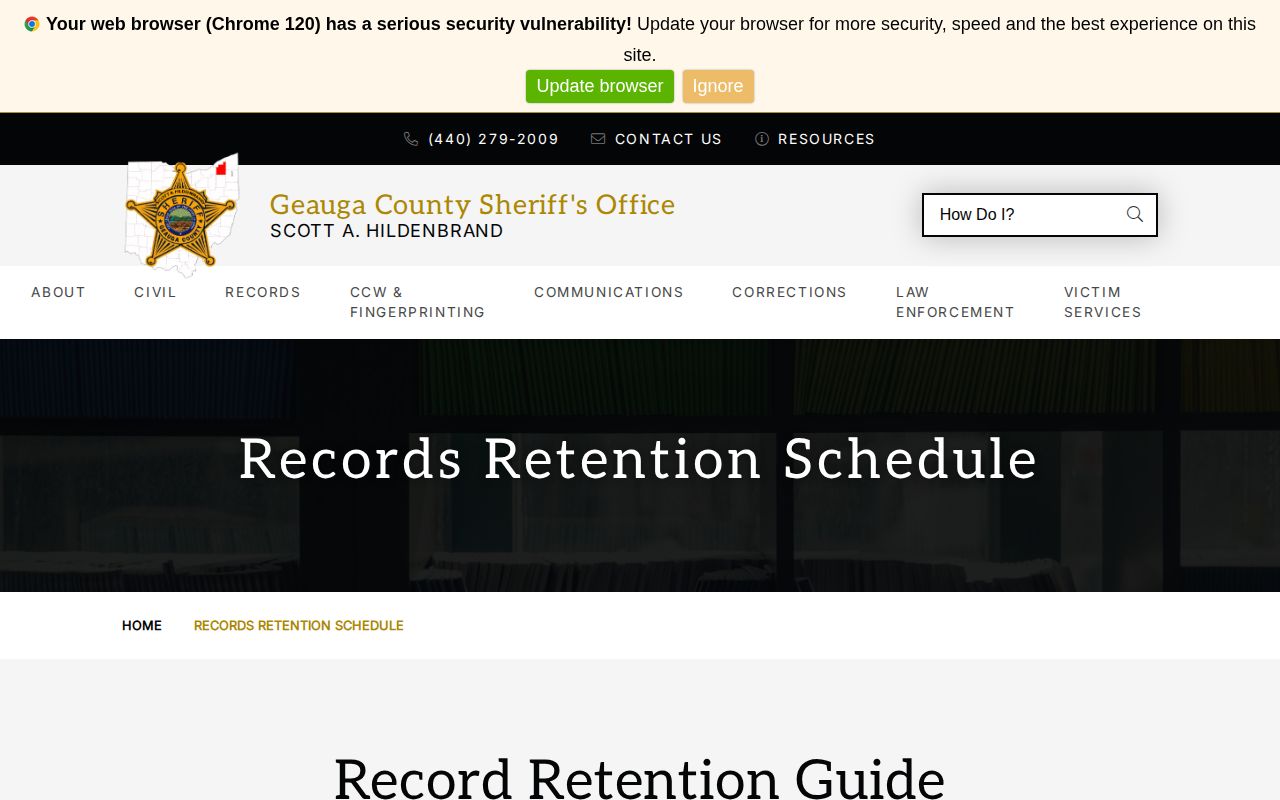
Note: Retention proves that a record series is kept; it does not guarantee that every field is public or present in each file.
Trace Geauga County Release Transfers
A three-day set can contain exits that lead into several systems. The Geauga County Safety Center handles local cases and also has a documented ICE detention function. A county record showing transfer to ICE is not a community release. ICE's online locator covers qualifying people now detained or released from ICE custody within its recent 60-day window, subject to stated omissions and lag.
State-prison commitments are searched through the Ohio Department of Rehabilitation and Correction. Its public status options distinguish Incarcerated, Released, APA Supervision, and Violators at Large. A person transferred from GCSO into ODRC custody should not be sought as a county-jail release after that handoff. Likewise, federal sentenced custody belongs in the Bureau of Prisons locator, while a federal pretrial transfer may require the court docket or U.S. Marshals records route.
| GCSO outcome | Where the trail continues |
|---|---|
| Bond, court release, or local term complete | Jail-register entry and Chardon Municipal or Common Pleas docket |
| ODRC commitment | ODRC Offender Search and the sentencing judgment |
| ICE transfer | ICE ODLS checked promptly, plus immigration records when needed |
| Federal transfer | Federal docket, USMS route, or BOP locator based on custody stage |
Verify Geauga County Three-Day Results
Use two sources when the distinction matters. The GCSO register answers when and how the county custody segment ended. The controlling court docket explains the order, bond, sentence, or other legal authority. A later warrant or holder can change the person's status after the release event, so note the date each source was checked.
Ohio VINE may provide an alert when the specific record and source agency participate. It is a notification tool, not sole proof. The state brochure also excludes municipal-jail offenders. For same-day scope, the Geauga County 24-Hour Releases method narrows the request to one day. A named-person inquiry can instead follow the Geauga County release-record path across county, state, federal, and immigration sources.
A current roster, if one later becomes available, would show who remains in custody at the time of its update. A released person usually drops from that kind of roster. The permanent register and booking file are designed for the historical event. That distinction is why the three-day request asks for release timestamps and destination rather than treating a no-hit as proof.
Preserve each source's exact wording. “Released” from county custody may be a community exit or an interagency handoff, depending on the destination field. “APA Supervision” means release from state prison with continuing Ohio supervision. A BOP result marked RELEASED confirms departure from federal prison custody, not the end of every federal obligation. ICE's recent result addresses ICE custody within that system's limited window. One broad label cannot safely replace those separate facts.